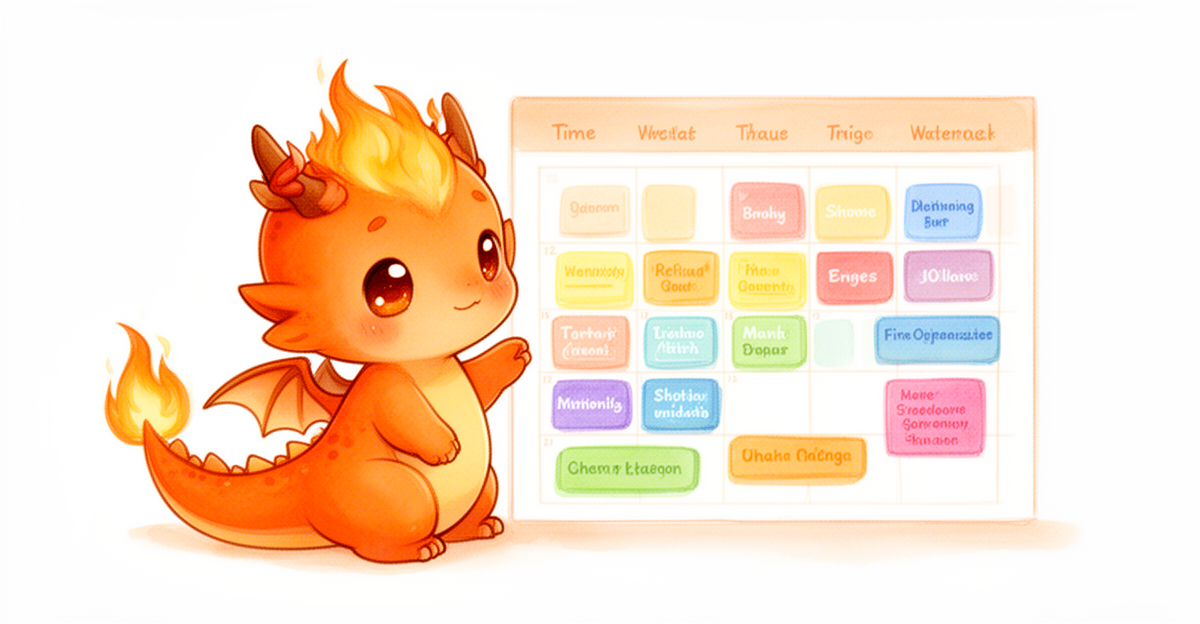
Deep Workflow: Building a High-Output Calendar with "Time Blocking" and "Energy Management"
In today's era of severe information fragmentation, most people work in a state of "passive response": their days are sliced into countless 15-minute fragments
📋 实验室验证报告
Deep Workflow: Building a High-Output Calendar with "Time Blocking" and "Energy Management"
In today's era of severe information fragmentation, most people work in a state of "passive response": their days are sliced into countless 15-minute fragments by emails, instant messages, and unexpected meetings. This state leads to significant "Context Switching Cost," meaning that even after a busy day, truly core output remains minimal.
To break this cycle, you need to upgrade from simple "time management" to a deep workflow combining "energy management + time blocking."
What is Time Blocking?
Time blocking is not just a simple To-Do List; it involves reserving an inviolable "physical space" on your calendar for specific tasks.
Core Logic: A to-do list tells you "what to do," while time blocking tells you "when to do it" and "how much time to spend on it."
1. Distinguish Three Types of Blocks
- Deep Work Block: 2–4 hours daily, reserved for tasks requiring high concentration (such as coding, writing in-depth reports, or strategic planning). Turn off all notifications and enter a flow state.
- Shallow Work Block: One or two 30-minute segments daily, used for handling emails, approval processes, and simple communications.
- Buffer/Recovery Block: Leave 15–30 minutes between major tasks for rest, walking, or handling unexpected minor interruptions, preventing the entire schedule from collapsing due to a single surprise.
How to Configure Your Calendar Based on Energy Curves?
The biggest misconception in time management is assuming that every hour holds equal value. In reality, your cognitive resources fluctuate throughout the day.
Energy Matching Matrix
| Energy State | Suitable Task Types | Time Block Recommendation |
|---|---|---|
| Peak | High-difficulty cognition, creative writing, complex problem analysis | Morning or 2–4 hours after waking $\rightarrow$ Deep Work Block |
| Trough | Administrative trivia, expense reimbursements, file organization, simple replies | Afternoon (14:00 – 16:00) $\rightarrow$ Shallow Work Block |
| Rebound | Lightweight creativity, team syncs, learning new knowledge | Evening or late night $\rightarrow$ Light Collaboration/Learning Block |
Practical Checklist: Building Your High-Output Calendar
- [ ] Audit One Week: Spend a week recording your actual energy fluctuation points (When are you most alert? When do you feel sleepiest?).
- [ ] Define Core Tasks: Every Sunday evening, determine the 3 "Key Results" (KRs) for the upcoming week, and prioritize assigning deep work blocks to them.
- [ ] Set Boundaries: Mark deep work blocks as "Busy" on your calendar and establish consensus within your team: unless it is an emergency, you are not to be disturbed during these periods.
- [ ] Force Shutdown: Establish a clear "Shutdown Ritual" to clean up unfinished items from the day and move them to tomorrow's calendar, completely cutting off work-related anxiety.
Gotchas & Considerations
Don't Over-Schedule
The most common mistake beginners make is filling every minute of their calendar. This causes immense frustration because if one task runs over, all subsequent plans collapse.
Countermeasure: Always leave a blank buffer of $\ge$ 15 minutes between major tasks.
Don't Disguise "Shallow Work" as "Deep Work"
Many people include "researching" or "reading reference articles" in their deep work blocks. In reality, these are often subconscious behaviors to avoid truly difficult thinking (Productive Procrastination).
Countermeasure: Separate "input/research" from "output/creation." Research is shallow or medium-depth work; true creation is deep work.
Strategies for Handling Unexpected Interruptions
When a boss or colleague inserts an urgent request during your deep work period:
- If it is truly urgent $\rightarrow$ Handle it immediately $\rightarrow$ Shift all subsequent time blocks backward on your calendar accordingly.
- If it is non-urgent $\rightarrow$ Reply: "I am currently working on a critical task and expect to finish by XX:XX. I will get back to you immediately after that."
Summary
High performers do not manage time; they manage attention. By matching tasks to energy states and locking in attention with physical time blocks, you can piece together fragmented days into a productive whole. Remember: one high-quality 2-hour deep work block often yields more output than an 8-hour office day filled with distractions.
⚙️ 安装与赋能
clawhub install skill-20260717-deep-work-flow安装后在你的 Agent 配置中启用此技能,重启 Agent 即可生效。