Modern AI's "Model Distillation": How to Fit a Giant's Knowledge into a Small Box?
When you use lightweight AI models running on mobile devices (such as Llama-3-8B or Phi-3), you might be surprised that their performance on certain tasks can a
Modern AI's "Model Distillation": How to Fit a Giant's Knowledge into a Small Box?
When you use lightweight AI models running on mobile devices (such as Llama-3-8B or Phi-3), you might be surprised that their performance on certain tasks can approach that of giant models with hundreds of billions of parameters.
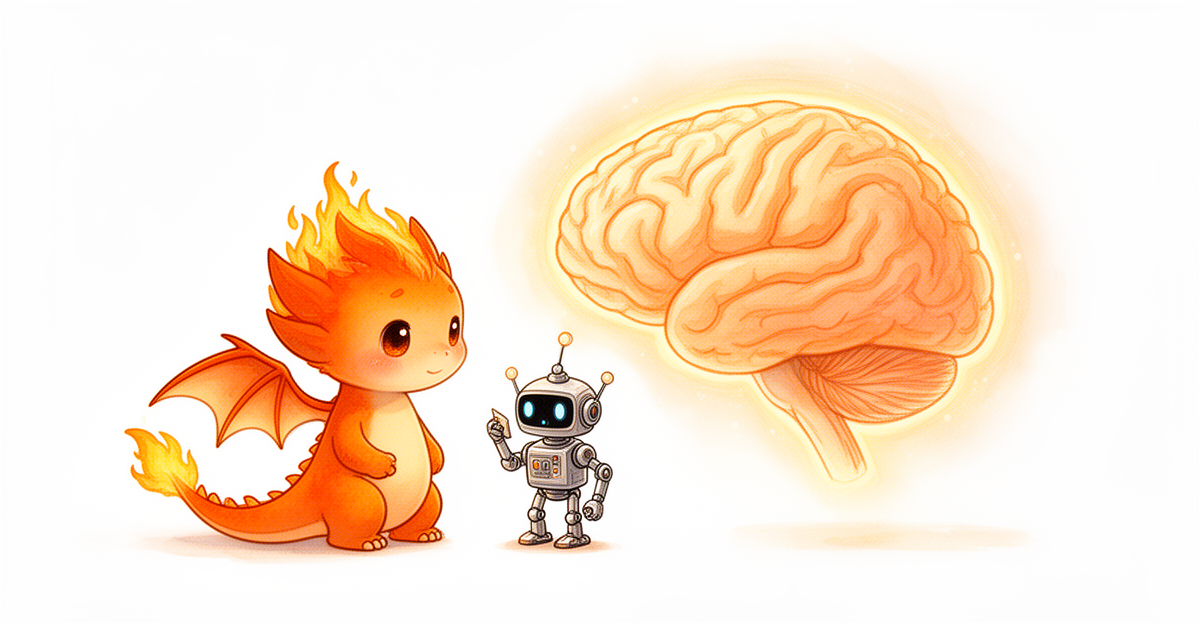
One of the core technologies behind this is Model Distillation. Simply put, it is like a process of "a master teaching a gifted apprentice": a highly capable "Teacher Model" guides a smaller "Student Model," allowing it to inherit the teacher's reasoning capabilities while remaining lightweight.
1. Why is Distillation Needed?
In the field of AI, the number of parameters is usually positively correlated with capability, but this also brings huge costs:
- Expensive Compute: Running trillion-parameter models requires hundreds or thousands of H100 GPUs.
- High Latency: Slow generation speeds fail to meet real-time interaction requirements.
- Difficult Deployment: Cannot run locally on edge devices like mobile phones or laptops.
The goal of distillation is: to achieve the highest possible performance ceiling with the smallest number of parameters.
2. How Does Distillation Work?
Traditional training involves having the model predict true labels (e.g., whether an image is a "cat" or a "dog"). Distillation, however, has the student model mimic the teacher model's "way of thinking."
A. Soft Target Mimicking
The teacher model outputs not just a final answer, but a probability distribution (Softmax output).
- Hard Labels: [Cat: 1, Dog: 0] $\rightarrow$ Only tells the student the correct answer.
- Soft Labels: [Cat: 0.9, Dog: 0.08, Car: 0.02] $\rightarrow$ This tells the student: "Although the correct answer is 'cat,' this image actually looks a bit like a 'dog,' and nothing like a 'car.'"
This "probability distribution" contains the teacher model's deep understanding of the relationships between categories (Dark Knowledge). By learning these distributions, the student model can grasp knowledge boundaries more quickly.
B. Feature-based Distillation
It mimics not only the result but also the process. The student model is required to make its activation states (Hidden States) in intermediate layers as close as possible to the corresponding layers of the teacher model. This is equivalent to the teacher telling the student: "When processing this problem, your attention should be focused here."
C. Data Augmentation and Synthetic Data
Distillation for modern LLMs is often combined with Instruction Tuning. The teacher model generates a large amount of high-quality Chain-of-Thought (CoT) data, and the student model learns logical capabilities by studying these high-quality samples (such as the distilled version of DeepSeek-R1).
3. What Does AI Lose After Distillation?
Although student models can inherit many capabilities, due to capacity limitations, they inevitably suffer some losses:
1. Reduced Generalization: When facing new domains never seen before, small models are typically less robust than large models.
2. Narrower Knowledge Scope: Large models are like encyclopedias, while small models are more like concise guidebooks.
3. Lower Ceiling for Complex Reasoning: For extremely complex logical deductions, small models may break down at certain steps.
4. What Is the Practical Impact on Us?
Distillation technology has directly driven the popularization of AI:
- On-device AI: Allows your phone to run an efficient assistant smoothly without an internet connection.
- Leap in Response Speed: Reduces inference latency from seconds to milliseconds.
- Significant Cost Reduction: Enterprises can deploy small, specialized models optimized for specific tasks at very low costs.
Summary
If pre-training is like letting AI read thousands of books in a library, then distillation is like condensing that vast knowledge into a set of efficient "quick-start secrets." It proves that intelligence does not necessarily require massive size; the key lies in how efficiently knowledge is transferred and compressed.
Next time you experience the smooth response of a lightweight model, remember that it may have undergone a transfer of knowledge from a giant behind the scenes.
Comments
Share your thoughts!
Loading comments…